AI Agents and Automation in 2026: What Actually Works in Production
The Year Agents Stopped Being a Demo
For most of the last three years, "AI agent" meant a compelling demo that fell apart on contact with real work. You'd watch a model book a flight in a sandbox, then try it on your own stack and discover it couldn't handle a rate limit, an expired token, or a form that rendered half a second late. The gap between the video and the Tuesday-morning reality was enormous.
That gap has narrowed sharply. Not because models suddenly became flawless, but because the scaffolding around them grew up. Tool calling became reliable enough to build on. Context windows got large enough to hold a real codebase or a quarter of project history. Standards emerged for connecting models to systems. And, most importantly, teams stopped trying to build one agent that does everything and started building narrow agents that do one thing repeatedly, correctly, and cheaply.
This guide covers what actually works in production right now: how agents are structured, which automations pay for themselves first, where they still fail, and how to tell the difference between a system that's genuinely working and one that's quietly producing plausible nonsense.
What Separates an Agent From a Chatbot
The distinction matters because it determines what can go wrong. A chatbot takes text and returns text. An agent takes a goal and runs a loop: it decides on an action, executes it against a real system, observes the result, and decides again — repeating until the goal is met or it gives up.
That loop is the whole story. It's what makes agents useful, and it's also what makes them risky. A chatbot that hallucinates produces a wrong sentence. An agent that hallucinates produces a wrong action — a deleted record, a duplicated invoice, an email to the wrong client. Every design decision below flows from managing that difference.
The Four Components That Matter
- The loop. Plan, act, observe, repeat. Simple to describe, and the part most teams over-engineer. A tight loop with three good tools beats an elaborate planner with twenty mediocre ones.
- Tools. The functions the agent can call — query a database, send an email, open a pull request, generate an image. Tools are the agent's entire surface area for affecting the world, which makes them the natural place to put your safety controls.
- Memory. What carries between steps and between runs. Most systems need far less than people assume: the current task state, plus a compact summary of what's already been tried.
- Termination conditions. The least glamorous component and the one that most often gets skipped. An agent without a hard step limit, a budget cap, and a definition of "done" is an open-ended bill.
Model Context Protocol and the End of Bespoke Glue
The single biggest practical shift has been the arrival of shared standards for connecting models to systems. The Model Context Protocol (MCP) — originally introduced by Anthropic and since adopted well beyond it — defines a common way for a model to discover and call tools exposed by a server.
The value is unglamorous but real: before, every integration was bespoke. Connecting an agent to your issue tracker meant hand-writing tool definitions, argument schemas, auth handling, and error translation, then doing it all again for the next model and the next tool. With a shared protocol, a server written once works across clients, and the integration surface stops being throwaway code.
If you're evaluating agent platforms in 2026, the practical question isn't "which model does it use" — models change every few months and you'll want to swap them. It's "how much of my integration work survives that swap." Standards-based tool connections survive. Hand-rolled glue does not.
Multi-Agent Systems: Useful, and Usually Premature
Multi-agent architectures get disproportionate attention: a planner delegating to researchers, writers, and reviewers, each with its own context and specialty. When the work genuinely decomposes into independent parallel subtasks, this is a real win — several agents exploring different parts of a problem simultaneously finish faster than one agent working serially.
But the failure mode is expensive. Every handoff between agents is a lossy compression step: agent A summarises its findings, agent B works from that summary and loses the nuance. Chain four of those together and the final output is confidently built on a game of telephone. Costs multiply too — each agent carries its own context, and you pay for all of it.
A reasonable rule: start with one agent and a good set of tools. Move to multiple agents only when you can point at a specific subtask that runs independently and produces a clearly-defined artefact. "It feels more organised" is not a reason. Measured latency or quality improvement is.
Orchestration Patterns Worth Knowing
- Sequential pipeline. Research, then draft, then review. Predictable and easy to debug because each stage has one input and one output. The default choice for content work.
- Parallel fan-out. Several agents attack independent subtasks at once, results merged at the end. Best when subtasks genuinely don't depend on each other — competitive research across five companies, say.
- Generator and critic. One agent produces, a second evaluates against explicit criteria and sends it back. Reliably improves quality, reliably doubles cost. Worth it for anything customer-facing.
- Human in the loop. The agent prepares the work and stops before the irreversible step. Underrated, and the correct default for anything that sends, publishes, deletes, or spends.
Automations That Pay for Themselves First
The temptation with a new agent platform is to automate the most interesting problem. The better strategy is to automate the most repetitive one. Interesting problems are interesting precisely because they need judgement — exactly what agents are worst at. Repetitive problems are boring because the judgement has already been made, which is exactly what agents handle well.
The automations that consistently deliver early value share a profile: they run often, follow a stable format, have a verifiable output, and cost little when they fail.
- Status synthesis. Turning raw activity — commits, closed tickets, moved cards — into a written update for stakeholders. High frequency, stable format, and errors are caught immediately by the people who did the work. See our guide on AI-powered project reporting for the mechanics.
- Intake triage. Classifying, tagging, and routing inbound requests. The agent proposes a category and priority; a human confirms with one click. Cheap to run and immediately measurable.
- Content drafting at volume. First drafts of posts, release notes, case studies, and social copy from a brief. The agent handles structure and coverage; a human handles voice and truth.
- Research digests. Monitoring sources and producing a summary with links. Low risk because every claim is traceable to a citation the reader can check.
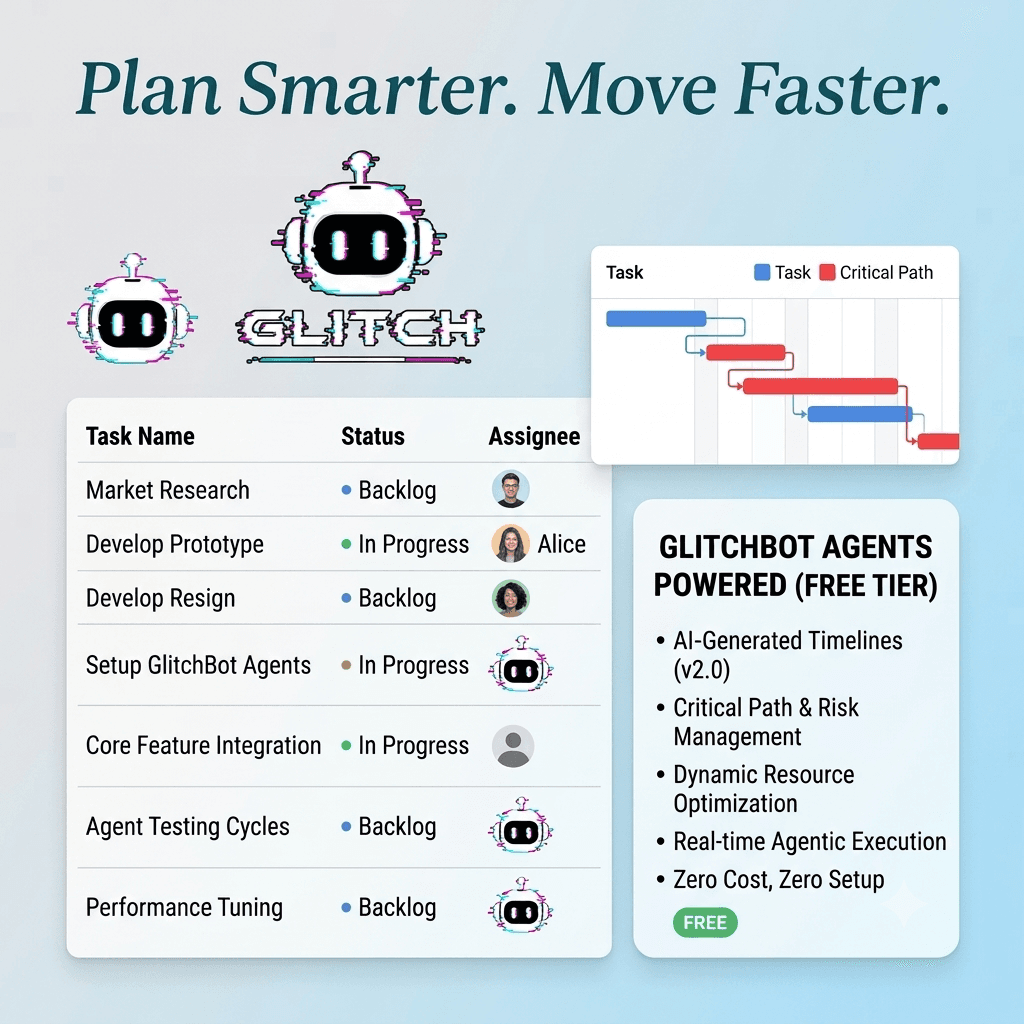
- Plan scaffolding. Turning a project brief into a first-pass task breakdown with dependencies and estimates — the approach behind AI-generated project plans. Nobody ships the first draft, but starting from 80% beats starting from a blank page.
Running Agents Unattended
There's a meaningful difference between an agent you trigger and an agent that runs on its own schedule. The first is a tool. The second is a system, and it needs the same operational discipline as any other background job.
We built exactly this into Glitch Bot's agent platform as Autonomous Mode, and the design constraints turned out to be more instructive than the AI parts. An unattended run works in cycles: research the current context, generate ideas, plan which artefacts are worth producing, create them, then report. Each cycle is bounded, each artefact is stored, and the run reports back by email so nobody has to sit watching a dashboard.
Four things proved essential, and they generalise to any unattended agent:
- A hard budget. Cap cycles, artefacts per cycle, and concurrent generations. An unbounded loop against a metered API is the most common way teams get a surprise invoice.
- Everything is a draft. Output lands in a review queue, not on your live site or in a customer's inbox. Publishing stays a deliberate human action — the cost of a bad automated publish is far higher than the cost of one extra click.
- Deliberate variety. Left alone, a generator collapses onto whatever type of output it produced last. Tracking what's already been made and steering away from it keeps a long run from producing forty near-identical blog posts.
- It reports to you. A run nobody hears from is a run nobody trusts. Per-cycle digests with what was made, what failed, and why turn a black box into something you can actually leave running.
The Scheduling Trap
One hard-won lesson: on serverless infrastructure, a long-running in-memory loop is a lie waiting to be discovered. The instance freezes between requests, timers don't fire when you expect, and work vanishes on the next deployment. If you want genuinely unattended operation, persist state to a database and drive cycles from a scheduled job. Anything else works beautifully in local development and fails quietly in production.
Where Agents Still Fail
Being specific about failure modes is more useful than another round of general caution. These are the ones that show up repeatedly:
- Confident wrong actions. The model calls the right tool with plausible but incorrect arguments. Nothing errors. The wrong record updates silently. Mitigation: validate arguments at the tool boundary, and make destructive operations require explicit confirmation.
- Context rot on long runs. Quality degrades as the context fills with accumulated history. The agent starts repeating itself or contradicting earlier decisions. Mitigation: summarise aggressively and reset context between logical units of work.
- Silent scope drift. Asked to fix one thing, the agent "helpfully" changes four others. Mitigation: narrow tool permissions and explicit instructions about what not to touch.
- Cost that scales invisibly. A retry loop that looks fine in testing becomes expensive at production volume. Mitigation: log token spend per run from day one, not after the first bill.
- Evaluation theatre. The output looks good, so the system is assumed to work. Mitigation: a fixed test set with known-correct answers, re-run whenever you change a prompt or model. Vibes are not a regression suite.
Measuring Whether It's Actually Working
Agent systems are unusually easy to fool yourself about, because the output is fluent whether or not it's correct. Three measurements cut through that:
- Task completion rate. Of runs started, how many produced a usable result without human intervention? Track it over time. A number that drifts down is the earliest warning that a prompt change or model update broke something.
- Human edit distance. How much does a person change before the output ships? An agent whose drafts get rewritten from scratch isn't saving time, whatever the completion rate says.
- Cost per accepted output. Not cost per run — cost per result that survived review. This is the only number that tells you whether the automation is economically worth running.
These are dull metrics. That's the point: agent systems fail in interesting ways and succeed in boring ones, and you want instrumentation that notices the difference.
A Practical Starting Sequence
If you're introducing agents to a team that hasn't used them, the order matters more than the tooling:
- Pick one repetitive task that someone does weekly and complains about. Not the most valuable task — the most tedious one with a checkable output.
- Run it with a human approving every step for two weeks. You'll learn where the model's judgement is unreliable far faster than any amount of prompt engineering.
- Remove approval only where the failure is cheap. Drafting: automate. Sending: keep the human. Reversibility is the criterion, not confidence.
- Instrument before you scale. Completion rate, edit distance, cost per accepted output. Get the numbers before you add a second use case, or you'll never know which change helped.
- Connect it to where work already lives. An agent producing output nobody sees is worthless. Wire it into the tools your team already opens — Jira, Notion, and Slack integrations exist for exactly this reason.
What's Coming Next
Two shifts look most consequential over the next year. The first is agents that operate computers directly — clicking through interfaces rather than calling APIs. This unlocks the enormous category of software with no meaningful API, and it's improving quickly, though it remains slower and more brittle than direct integration. Use it where no API exists, not as a default.
The second is longer-horizon autonomy: agents that work for hours rather than minutes, maintaining coherence across a substantial task. The bottleneck here isn't intelligence but state management — keeping track of what's been tried, what worked, and what the original goal was, without drowning in context. Progress on that problem will matter more for real-world usefulness than the next benchmark score.
What won't change is the fundamental requirement: agents need clear goals, bounded permissions, verifiable outputs, and someone accountable for the result. Teams that build that discipline now will adopt each new capability smoothly. Teams waiting for a model good enough to skip it will be waiting a while.
The Takeaway
Agents have crossed from demo to daily utility, but the value isn't in the autonomy itself — it's in the compounding effect of small, reliable automations running consistently. One agent producing a decent status update every Monday delivers more real value over a year than an elaborate multi-agent system that impresses in a demo and gets quietly switched off in week three.
Start narrow. Keep a human on the irreversible steps. Measure cost per accepted output. Expand only where the numbers justify it. That's an unexciting recipe, and it's the one that works.
If you want to see continuous agent work in practice, Glitch Bot's agent platform runs research, planning, and content generation on a schedule, files everything as reviewable drafts, and emails you a digest of what it produced. It's the operational discipline described above, built in. Start a 7-day free trial and put a cycle to work on your own project.