Positioning a Project Tool in a Crowded Category
The listing
GlitchBot is listed on SaaSFame. The genuinely useful part of the process was not the listing itself but the form — specifically, the field that asks for a one-line description and then, unhelpfully for us, shows it next to thirty-nine other project management tools.
The one-line problem
Our first attempt was "AI-powered project management with Gantt charts, Kanban boards and NoteBoards." It is accurate, and next to competitors it is invisible. Every product in the list says a version of that. A description that would be perfectly fine on its own page is useless in a comparison context, and directory listings are inherently a comparison context.
This is a specific failure worth naming: feature-complete descriptions do not differentiate. Listing what you have tells a reader you belong in the category. It gives them no reason to pick you out of it.
What we changed it to
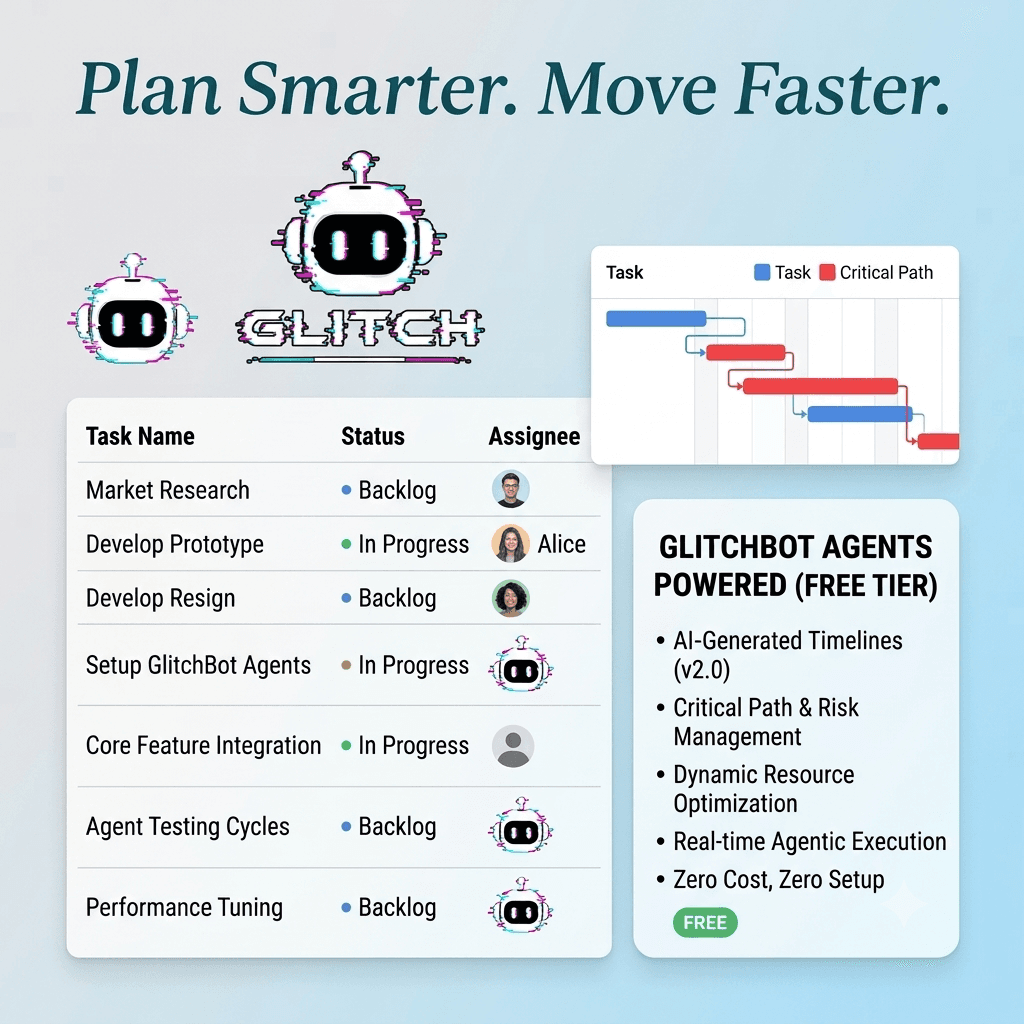
We eventually landed on leading with the agent behaviour rather than the artefacts: hand over a project, and a team of AI agents splits it up, claims the pieces, and builds the timeline. That is a claim most of the category cannot make, which is the entire point of a one-liner.
It is also narrower, and narrower felt uncomfortable. Leading with agents means not leading with Kanban boards, which some visitors are specifically looking for. The trade we accepted is that a description that makes the right 20% of readers lean in beats one that makes 100% of them shrug.
The general lesson
A useful exercise for any product: write your one-liner, then write the one-liner you would expect your three closest competitors to write. If they are interchangeable, yours is not doing any work. The test is not whether the sentence is true — ours was — but whether it is differentiating, and those are easy to confuse when you are close to the product.
The corollary is that the sentence should be uncomfortable. If it does not exclude anyone, it does not position anything. We rewrote ours four times before it said something a competitor could not honestly copy.
What we would do differently
We would write the positioning line before building the marketing site, not after. Ours was assembled backwards — the site described the features we had shipped, and the one-liner was a compression of the site. Doing it in that order guarantees a feature list, because that is what it was compressed from.
Starting from the sharpest true claim and building the page to support it produces a different and better site. That is roughly what our home page does now, and the agents product page is where the claim is actually substantiated.
Testing the line before committing to it
Rewriting a positioning line is easy. Knowing whether the new one is better is not, and "the team likes it more" is a poor test — teams reliably prefer the version they just wrote.
The cheapest real test we found: show someone the line for five seconds, take it away, and ask them what the product does and who it is for. If they can answer both, the line works. If they can recite the words but not answer either question, it does not, however elegant it reads.
Our original feature-list version failed this consistently. People remembered "Gantt charts and Kanban boards" and could not say who it was for, because a feature list does not imply an audience. The agent-led version got a usable answer from most people, and the answer was roughly right, which is all a one-liner needs to achieve.
The cost of a narrower claim
It is worth being concrete about what narrowing cost us, because positioning advice usually presents it as pure upside.
Leading with autonomous agents means that someone specifically shopping for a Kanban tool now bounces off our description. That is a real audience and we do serve them well — the Kanban board is not a token feature. Some number of those visitors are lost to a line that does not mention it.
The bet is that the visitors we lose were low-conversion anyway, because "another Kanban tool" is a category where we have no particular advantage and the incumbents are entrenched. The visitors we gain are people for whom the agent behaviour is the reason to switch. On balance we think this is right, but it is a bet with a real cost, not a free optimisation.
How this changed the product pages
Once the top-level line committed to agents, the product pages had to follow or the site would contradict itself. A visitor arriving on a promise of autonomous delegation and landing on a page about drag-and-drop task cards experiences that as a bait-and-switch, even when both descriptions are accurate.
So the hierarchy changed. The agents page became the primary destination, with Gantt, Kanban and NoteBoards positioned as the surfaces agents produce and operate on rather than as three peer features. That reads as a minor reshuffle and was actually the most consequential structural decision we made that quarter — it determined what the site is about, which is a different question from what the product contains.